
Home Blog Page 152

Ramayana Part-2 : Swayamvar

0
At a short distance from the boundaries of Ayodya, there was a forest in which was situated sage Vishwamitra’s hermitage. There the sage used to perform Yajnas in the company of other ascetics and hermits. But the Rakshasas (the demons) had grown very powerful. Two of them, Marich and Subahu, used to disturb the sages be desecrating the alters.
Ramayana Part-2 Swayamvar (2)
When the ascetics and sages could no more tolerate the undesirable intrusion by the Rakshasas, they requested Vishwamitra to do something.
Assuring his fellow sages, Vishwamitra decided to approach Dashrath, the King of Ayodhya. Next day while Dashrath was in his court, a guard came and said. “Your Majesty! Sage Vishwamitra has come to meet you.”
Ramayana Part-2 Swayamvar (3)
King Dashrath was alarmed at the news of Vishwamitra’s arrival. He looked towards sage Vasishtha. The sage said, “Don’t worry. Let us hope Vishwamitra’s visit proves auspicious. Please go and welcome him.”
Acting upon the advice of the family priest, King Dashrath at once went out of the palace to receive sage Vishwamitra. He touched the sage’s feet and said, “Your pious presence has made Ayodhya a holy place. “ The king led him to the court and offered him a seat near sage Vasishtha.
When Vishwamitra had taken the seat, Dashrath said with folded hands, “What service can I render?”
“The Rakshasas create trouble and let us not perform Yajnas. They throw bones and filth into the sacrificial fire.”
Ramayana Part-2 Swayamvar (4)

Sage Vishwamitra further said, “We, the sages and ascetics, want you to provide us with protection.”

“Stop worrying, Your Holiness! I shall send my soldiers who will kill any Rakshasas who comes near your Yajna altar. And, if required, I myself shall go there. You may rest assured,” said King Dashrath.

“No, your solders will be of no help. Send Rama and Lakshmana with me. Then every thing will be set right,” said Vishwamitra.

King Dashrath was put in dilemma. H got nervous and said, “How can these boys fight those numerous Rakshasas?”

“You are free to refuse if you so desire,” saying this with anger, Vishwamitra got up to leave.

Ramayana Part-2 Swayamvar (5)

When sage Vasishtha saw that Vishwamitra was annoyed, he pleaded with him not to get agitated. He requested him to take his seat and said, “Please be calm.”

“Why don’t you ask Dashrath not to argue but to do as I say?” said sage Vishwamitra.

Sage Vasishtha said to King Dashrath, “O King! Don’t be a slave of blind love and ignorance. Let Rama and Lakshmana accompany sage Vishwamitra to the forest. They will be gaining something there.”

Dashrath’s fears were removed. He at once called Rama and Lakshmana there and, handing them to Vishwamitra, said, “Please excuse me. I was at fault. Now onwards, they will be at your service till you so wish.”

Ramayana Part-2 Swayamvar (6)

There is no reason to be worried of. Both of your sons will return richer with experience,” thus assuring King Dashrath, sage Vishwamitra led Rama and Lakshmana out of the palace.

While passing through the forest on their way to Vishwamitra’s hermitage, they were confronted by Taraka, a wicked she-demon. When she saw two young princes accompanying the sage, she was tempted to eat them. She dashed towards them.

“Rama, Beware! She is Taraka. The main creator of trouble in the forest,” sage Vishwamitra warned Rama.

Rama immediately killed Taraka with an arrow shot from his bow. In the hermitage, the sage trained the two brothers in the use of divine weapons. After that training, they were fully prepared to fight the demons.

Ramayana Part-2 Swayamvar (7)

Rama said to sage Vishwamitra, “Respected Sir! Now you may proceed with the performance of Yajnas without any fear.”

“May God bless you with long life,” said the sage and he got busy with the rituals, along with his fellow ascetics and hermits.

The news of Taraka’s killing made both Marich and Subahu mad with rage. They reached the Yajna site to desecrate it. A usual they began throwing flesh and bones of dead animals in the sacred fire.

Rama at once shot an arrow which rotated above the sacred altar with such a speed that it formed an umbrella and the Rakshasas failed in their attempt to disturb the holy rituals of the Yajna.

Ramayana Part-2 Swayamvar (8)

On the sixth day of Yajna, Marich and Subahu again came there with a large number of their followers. They were determined to desecrate the holy site of Yajna.

Rama and Lakshmana were standing alert to guard the place. When they saw Rakshasas throwing filth and bones towards the sacred fire of the Yajna from above, Rama lost temper. He said to Lakshmana. “the Rakshasas will not mend their ways unless punished.”

“Permit me to kill them all,” said Lakshmana with his bow ready to shoot.

“Well! You will engage Subahu and let Marich be my victim,” saying so, Rama drew his bow and instantly Marich was hit by the arrow which took and threw him and instantly Marich was hit by the arrow which took and threw him in the ocean a hundred miles away. Subahu was killed by Lakshmana.

Ramayana Part-2 Swayamvar (9)

The Yajna was completed without any further disturbance. A few days later, sage Vishwamitra received an invitation from King Janak of Mithila to grace the Swyamwar of his daughter Sita. The sage said to the two brothers, “King Janak has asked me to bless his daughter Sita for whose marriage a Swyamwar is being held. I would like you both to go there with me.”

“We shall be honoured to obey your order.” Said Rama and Lakshmana with humility.

On their way to Mithila, they saw a vacant hut, with a huge stone lying outside it, in the forest. Fama asked sage Vishwamitra what that was and why the hut was unoccupied.

“This is sage Gautam’s wife Ahilya who was cursed and turned into stone by the sage,” said Vasishtha.

Ramayana Part-2 Swayamvar (10)

When asked by Rama, Vishwamitra related the story, “Ahilya was an extremely beautiful woman. Once Moon god, bewitched by her beauty, entered the sage’s bedroom in the guise of Gautam while he was away. Ahilya could not recognise him. While Moon god was leaving the hut, sage Gautam returned. He got annoyed and cursed Ahilya to turn into stone. Since then she has been waiting for you. Go and liberate her from the curse with the touch of your foot.”

As soon as Rama touched the stone, it regained the form of young beautiful Ahilya. Washing Rama’s feet with her tears, she said, “I was a sinner. You have granted me salvation. No doubt, you are God incarnate.” Having said so, she left for the heaven.

Ramayana Part-2 Swayamvar (11)

In Mithila, sage Vishwamitra stayed in a beautiful garden, with Rama and Lakshmana. King Janak came there to pay his respects. The sage blessed him and told him who Rama and Lakshmana were.

King Janak himself escorted sage Vishwamitra and Dashrath’s sons to the hall where Swyamwar was to take place. On a dais the grand now of lord Shiva was placed. Only he could ask for Sita’s hand who would tie the string of the bow first of all. Sita was also brought in the hall by her friends and maids. Every one, present there, was captivated by her beauty.

When every thing was ready, King Janak asked the royal bard to announce the condition of the Swyamwar.

Ramayana Part-2 Swayamvar (12)

The royal bard proclaimed, “O Brave Princes! This bow of lord Shiva is not only very heavy but also very hard to bed. Valiant warriors like Ravan and Vanasur have not been able to raise it an inch even. He who succeeds in tying its string, shall be chosen by princess Sita as her husband.”

Many kings and princes tried their best but failed in their attempt to fulfil the condition. Those, who boasted of their physical prowess, had to face humiliation. The foolish ones made laughing stock of themselves. Those, who were mature and wise, did not try.

King Janak began to lose heart at what was happening. He feared his vow would prove an injustice to his daughter. He felt himself a culprit.

Ramayana Part-2 Swayamvar (13)

Out of disappointment, Janak lost temper. He said, “So many kings and princes, big and small, have come here from different states and islands. Is it not strange that there is not even a single soul present here who can tie the string to win the hand of Sita, my daughter? I don’t understand the reason for the failure of all of you to even move it. I am convinced that this earth has no brave man left upon it. None must think oneself valiant any more. Now, you may please leave this place. Perhaps my daughter is destined to live and die as a virgin. I curse myself for having vowed to ask for the fulfilment of such an impossible condition. I hold myself responsible for the ill lick of my daughter. Even gods and demigods, present here, appear to be helpless.”

Ramayana Part-2 Swayamvar (14)

At the use of insulting words by King Janak, Lakshmana could not control himself and said, “None dares to speak such a language in any gathering where any of Raghu’s descendants is sitting. King Janak should have know it. I declare, with all the humility at my command, that, I permitted by my elder brother, I shall spin this universe like a ball. This old bow is insignificant.”

Lakshmana’s lion-like roar created panic amongst the princes and kings present there. Rama pacified Lakshmana and made him sit down. Sage Vishwamitra smiled and said to Rama. “Get up and tie the string of the bow so that King Janak is relieved of the tension.”

Rama, after bowing before the sage, walked up to the dais and attempted to pick up the bow.

Ramayana Part-2 Swayamvar (15)

When Sita’s mother looked at the child-like innocent face of Rama, she was perturbed. She said to her sister-in-law, “Oh Dear! Why does any body not tell the sage that Rama is still a boy. How does he expect him to tie the string of lord Shiva’s bow?”

“No, Sister! Don’t underestimate the sages and ascetics. Don’t you know that sage Agastya dried up the ocean. Gods like Brahma, Vishnu and Mahesh are helpless before a small incantation,” said Sita’s aunt assuring the queen.

Sita, on the other hand, was praying to lord Shiva to grant success to Rama by reducing the weight of the bow. Just then Rama picked up the bow like a toy and drew the string to tie it on the other end of the bow

Ramayana Part-2 Swayamvar (16)

When Rama tried to bend the bow to let the string reach the other end, it broke into two with a big bang. The sound of the bang was deafening. The hall resounded with its echo. Everybody was forced to put fingers into the ears. All were stunned, but King Janak was very happy.

Rama threw the two pieces of the bow on the ground. Atmosphere of melancholy vanished at once. Musicians began to play upon their instruments and dancing girls started dancing without being ordered, just out of joy.

King Janak immediately left his throne and stood before Rama, saying, “O Rama! You have saved my honour which I had almost lost. I thank you for this. I am proud that Kshatriyas still walk over this earth.”

Ramayana Part-2 Swayamvar (17)

The exploding sound, created by the breaking of lord Shiva’s bow attracted the attention of the great sage Parshuram of the Bhrigu dynasty. He at once reached the Swyamwar-site and challenged him who had invited his death by breaking the bow.

King Janak tried to calm down Parshuram but he would not listen to any argument. He said, “Tell me the name of the person who dared to break lord Shiva’s bow. Otherwise I shall turn this planet upside down.”

King Janak kept quiet. Rama said, “O Respected Brahman! May be that person is one of your devotees.”

“No, it cannot be. The bow-breaker is my enemy and I shall not let him live any more,” said Parshuram with ange

 
Ramayana Part-2 Swayamvar (18)

Angry threats of Parshuram made Lakshmana smile. He said, “We do not remember the number of such ordinary bows broken by us in our childhood. But you never lost temper then. What makes you so much annoyed now? Is there anything special about it?”

“You fool! Don’t you know you are standing in front of death? That is not an ordinary bow, it is Lord Shiva’s bow which no human being can move a bit,” was Parshuram’s reply.

“We don’t find any difference between this bow and any other one. It was an old useless bow and broke into two at the touch of brother Rama. How can you blame him?” said Lakshmana.

“I am known as the destroyer of Kshatriyas. Shut your mouth and save your life,” retorted Parshuram.

Ramayana Part-2 Swayamvar (19)

“O Great Brahman! We have tolerated you because we do not hit a god, a Brahman, a saint and a cow. So, provoke me not,” said Lakshmana.

Parshuram lost self- control at what Lakshmana had said. He shouted, “Vishwamitra! This boy is not only foolish but also arrogant. I was still now lenient because of your young age,” saying so, he raised his axe to attack Lakshmana.

Rama stood in Parshuram’s way with folded hands and requested him to excuse Lakshmana as he himself confessed to be the offender. He said, “I am your humble servant. How can I fight you? Otherwise, we, the Raghuvanshis, fight with death itself.”

Then Parshuram gave his own bow to Rama to draw its string. When Rama did so, Parshuram by then knew that Rama was not an ordinary man. He bowed before Rama out of respect.

Ramayana Part-2 Swayamvar (20)

When King Janak found that Parshuram had been pacified, he gestured to Sita’s friends to lead her to Rama. Standing before him, she glanced at Rama and put the flower garland around his neck. That indicated her choice of Rama as her husband.

Parshuram blessed both Rama and Sita and, hailing Rama, went out of the hall. Gods from the heavens showered flowers on the couple to show their approval and pleasure. Then Janak said to sage Vishwamitra, “Please advise me what to do next.”

“O King! Send some messenger to Ayodhya to inform King Dashrath so that he comes here for the solemnisation of the marriage,” replied Vishwamitra.

Janak at once despatched his man to Ayodhya.

Ramayana Part-2 Swayamvar (21)

Janak’s messenger, after reaching Ayodhya, did not take much time in meeting the telling Dashrath of Sita’s choice of Rama as her husband. King Dashrath was very happy and excited. He sent the happy news to his queens without losing any time.

Bharat and Shatrughna cane running to their father as soon as they heard of the message of King Janak. Dashrath asked Bharat to make arrangements for taking marriage party to Mithila.

“As you order,” saying this Bharat and Shatrughna got busy with the job. Chariots, elephants and horses began to be decorated. King Dashrath with the family priest sage Vasishtha, relatives, courtiers and other elites of the city reached Mithila the very next day.

 
Ramayana Part-2 Swayamvar (22)

The people of Mithila were over-awned with the grandeur of the marriage party. Marriage party was also pleased at the grand reception given to them.

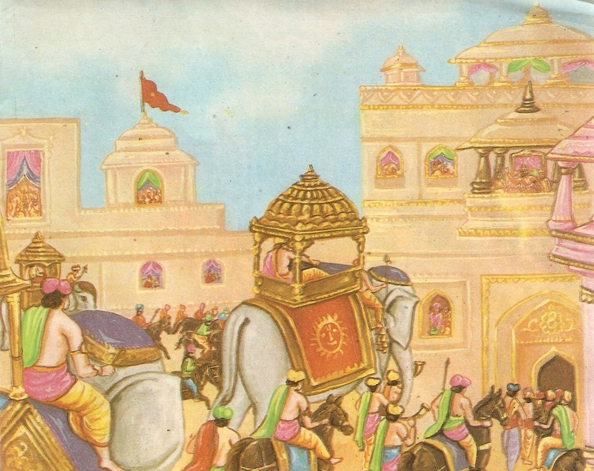
King Janak and his relatives welcomed King Dashrath and other members of the party with great respect and enthusiasm. They escorted the guests to the place where marriage ceremony was to be performed. Reaching there, King Janak requested his family priest Shatananda to perform the ceremony. He further said, “You may please solemnise the marriages of the four brothers at he same altar.” This Lakshmana was married with Urmila, Janak’s second daughter and Bharat and Shatrughna with Mandavi and Shrutikirti, the daughters of Janak’s younger brother Kushadhwaj.
Ramayana Part-2 Swayamvar (23)

After the ceremony, Janak gave cart-loads of ornaments, jewels, clothes and other valuables as dowry to his and his brother’s daughters.

At the time of the departure of the marriage party, Janak got emotional and said to King Dashrath, with tears in his eyes, “O King of kings! We feel ourselves fortunate to be bound with you be relation. This has enhanced our prestige. Please treat me as your slave. We may be excused for any lapse on our part during your stay here.”

“Dear brother! The truth is otherwise. I think myself lucky to call myself a relative of a noble and saint king of your status.”

Then the marriage party left Mithila with the brides and reached the outskirts of Ayodhya.

Ramayana Part-2 Swayamvar (24)

The entire city had turned out to welcome the king, the princes and the brides. Every house and shop, every land and square was decorated with flowers and buntings. Every body was in a festive mood.

Before entering the city, Dashrath worshipped god Shiva, Parvati and Ganesh, as advised by the family priest sage Vasishtha.

Kaushalya, Kaikeyi and Sumitra were standing at the main gate of the palace, with golden trays full of flowers, incense and sweets. They were there to receive their sons and their brides.

After greeting them, Kaikeyi donated a large quantity of golden ornaments and clothes to Brahmans and others as a votive offering. Then the brides were led into the palace in the company of singing women.

Ramayana Part-2 Swayamvar (25)
 

Ramayan Series

Part-1: Childhood | Part-2 : Swayamvar | Part-3 : Dasharatha’s Promise | Part-4 : Vanvas | Part-5 : Sita Haran | Part-6 : Meeting Hanuman | Part-7 : Lanka Dahan | Part-8 : Lanka Yudh | Part-9 : Lanka Vijay | Part-10 : Ayodhya | Part-11 : Lav Kush | Part-12 : Ram Rajya

Ramayana Part-1 : Childhood

0

Long, long ago, there was a king named Dashrath in India. He had his capital at Ayodhya. He was a brave but God-fearing ruler who loved his subjects as his children. He had three queens named Kaushalya, Kaikeyee and Sumitra. The queens were very beautiful, pious and virtuous ladies.

Dashrath belonged to the dynasty started from the Sun-god himself. So, he worshipped the Sun daily as a guided by the royal priest who was named Vasishtha.
In spite of the comforts of stately life, the king and his three queens were not happy. The reason was that none of the queens had given birth to any child so far. So, the kingdom was without a crown-prince.

Dashrath Worshipping


The King and the Queens were well past middle age. So, the king had lost all hope to be blessed with a son. “Who will succeed to my throne after me?” he often asked himself.

One day after the usual worship, King Dashrath prayed to Sage Vasishtha, “Do something, please, so that I may not die without leaving a heir to my throne.”

King Dashrath prayed to Sage Vasishtha


Sage Vasishtha consoled the king saying, “Don’t worry at all, O king; you shall be blessed with sons. But you will have to perform the putreshti Yajna (son-granting worship).”
The king folded his hands and said, “I am ready to do anything.” He, then, requested the royal priest to make arrangements for the son-granting worship.

Agni Dev granting the wish

“This worship is to be performed by Saint Shringi. Go to his hermitage bare-foot and request him for it,” remarked Vasishtha.

Next day, king Dashrath approached Saint Shringi. Touching his feet respectfully, he said, “Sage Vasishtha has directed me to you, sir. Be kind to perform the son-granting worship for me. “
The saint agreed and accompanied the king to Ayodya. He performed the worship. As soon as it was over, the Fire-god appeared out of the fire with a pot in his hands. It contained the holy Prasad for the queens.

“Your wish is granted, O king! Take this pot to you palace and ask your queens to share its contents,” said the god. Saying so, he disappeared. The king was very happy indeed.

Dashrath giving Prasad

After the Yajna, Saint Shringi left for his hermitage. Seeking Sage Vasishtha’s permission, king Dashrath went into the palace. Seeing a pot in his hand, all the three queens cane running to him. They were very excited indeed.

“What is there in this pot?” asked the queens. The king told them all about the Yajna and handed over the pot to Kaushalya, the eldest queen. Then all the three queens shared the Prasad as directed by Fire-god.

Kaushalya with Ram and Lakshman

Before long, th king got the news that all the three queens were in the family way. He was beside himself with joy. In his heart of hearts, he thanked the Almighty and both the saints as well. His wish was going to be fulfilled.

Days rolled by followed by weeks and months. In time, approached the day of the births of four princes of Ayodhya. This auspicious day was the ninth day of the waxing moon in the month of Chaitra. The three queens bore four lovely sons in the evening. King Dashrath had become the father of four sons.

Kaushalya, the eldest queen, gave birth to one son and Kaikeyee too. But Sumitra bore two male twins. The town of Ayodhya put on a new look and celebrations went of for a number of days.

As for the royal palace, it resounded with shouts of joy. Everyone was happy at the births of the princes. The maids and attendants were given awards and gifts by the king and the queens. There was joy and bliss everywhere around.

Happy Dashrath giving gifts

Festivities continued for days together on end. Bazaars and streets were profusely decorated with bunting and colourful gates. Rows of lit lamps were kept on the balconies at night. Ladies of the town were specially happy. They marched to the palace in groups singing joyful songs to congratulate the queens.

King Dashrath despatched a special messenger to convey the happy news to Sage Vasishtha. The Sage came to the palace to bless the new-born princes. A large number of sadhus and Brahmans were with him too.
The king paid his respects to all the saints and gave them gold, clothes and cows in alms. Saint Shringi was specially honoured in a befitting manner. He blessed the entire royal family and the four princes in particular.

Sage Blessing Ayodhya Prince


Merriment and celebrations went on for over a month. When the princes were forty days old, their christening ceremony was held. The king requested Sage Vasishtha to suggest befitting names for the four princes.

The royal priest (Vasishtha) performed the naming ceremony and named Kaushalya’s son Rama, the source of bliss. As for Kaikeyee’s son, he named Bharata – caretaker of one and all.
“Queen Sumitra’s eldest son is born to destroy the enemies; so he should be named Shatrughna. Her youngest son is to possess the best of human qualities. So, he is to be named Laxmana,” said Sage Vasishtha.
The queens like the names very much. They were indeed extremely delighted.

Ramayan ChildHood


Rama, the eldest prince, had a sallow complexion. But he was extremely handsome. The gold chain around his waist and the amulets on his arms added to his personal charms all the more. He was the apple of the king’s eye. All the three queens loved him most dearly too.

Rama’s movements and pranks were very fascinating indeed. He was the talk of the entire palace. Whoever saw him, he/she wanted to take him into his/her arms and fondle him lovingly.

All the other three princes were fair-complexioned. The king and the queens were almost always lost in their dear sons. They fed them with their own hands and could ill-afford to let them be away from their eyes even for a moment.

Ayodhya Princes practices archery


In due course, the princes grew young. The king requested the royal priest to perform their thread ceremony. This done, their formal education started. First of all, they were imparted training in shootingarrows.

Rama was the most handsome and lovable of all the princess. He was cool-tempered and patient by nature. Lakshmana was more attached to Rama from the very beginning though he was quick to anger. As for Bharata and Shatrughna, they were very intimate.

As the princes grew up further, the king decided to send them to the ashram (hermitage) of Sage Vasishtha for all-round education befitting the then princes.

Ramayan Part 1 ChildHood (14)

There they were to live as continents (brahmacharis) till the age of 25 years and attain knowledge at the feet of the great guru.

The princes were soon informed that they were to go to the hermitage of the royal priest. So, they prepared themselves for that. Soon, they got their hair shorn and dressed up as continents in coarse clothes of saffron colour.

Then the princes, led by Rama; went to their mothers to seek their permission to leave the palace. The mothers felt shocked at the very idea of separation from their sons. But the family tradition was to be followed.  So, they had to send them off but with heavy hearts and tears in their eyes.

Vasishtha giving lessons

At Sage Vasishtha’s hermitage, the princes started learning various disciplines at the feet of the great teacher. The Sage imparted them knowledge befitting the princes of a great kingdom.

The princes devoted themselves to studies and served the sage as humbly as they could. He imparted them to the knowledge of the three aspects of Gods power – Creation, Preservation and Destruction.  Also, he told them that the life-span of a man has four parts:

  • From birth to the age of 25 years Brahmacharya (continence)
  • From the age of 25 yeas to the age of 50 Girhasth (house-holder)
  • From the age of 50 years to the age of 75 Vanapractha (detachment)

From the age of 75 years to death Sanyas (renunciation)

Ramayan Part 1 ChildHood (10)

Sage Vasishtha imparted instruction on state matters too to the four princes. Apart from it, he guided them in day-to-day worldly dealing as well. He explained to them the use of saam (allurement), daam (greed), dand (punishment) and bhed (division).

As for the spiritual teaching, the great teacher said, “Three qualities are found in human-beings.”

  • The Satva (higher values, i.e. virtues)
  • The Rajas (worldly values, i.e. luxuries)
  • The Tamas (baser values, i.e. vices)

Every person has one type of the above mentioned qualities in himself/herself prominently. Whereas virtues lead a man to piety and goodness, vices lead him to impiety and evil.”

Ramayan Part 1 ChildHood (11)

Sage Vasishtha explained to the princes that human body is made up of five elements – air, water, fire, earth and space. Also, that man is the supreme creature among all living-beings.

The Sage said. “One must hold his parents and teachers in high esteem. They must be loved, served and respected.”
“Moreover, truth is the greatest power and it always conquers in the end. Untruth or falsehood leads to sins.”
“Love of creatures is love of God whereas hatred earns his wrath.”

The princes took an oath to follow the instructions of the great teacher to the letter. They were now well-informed to step into the life of house-holders.

Ramayan Part 1 ChildHood (12)

The princes were just nearing the end of Brahmacharya period. So, Sage Vasishtha decided to teach them the duties of a good ruler and the art of state-craft.

The Sage said, “A ruler must know that the crown he wears is not a sign of greatness. It is a basket of duties towards his subjects. If a ruler performs his duties well, he is certainly great. But if he ignores them, he is sure to have a fall.

Protection of the people is the first and foremost duty of a ruler.”
“Secondly, he must be just and impartial in every matter.”
“Thirdly, he must try to make his people happy and prosperous.”

“In short, if a king is greater than his people, his duties are far heavier and harder too,” said the great Sage.

Ramayan Part 1 ChildHood (6)

The education of the princes having been complete, Sage Vasishtha sent message to king Dashrath. The king at once followed that the sage wanted the princes to return to Ayodhya. So, he sent Sumanta, his prime minister, to bring them home.

Sumanta collected stately robes for all the four princes and got ready to go to the hermitage of the sage. The queens were very impatient to see the princes.
The queens asked Sumanta to return without delay along with their sons. The king and the queens sent presents for Sage Vasishtha and other students of the ashram as well.

Sumanta left Ayodhya in a chariot promising the queens to return soon with their sons.

Ramayan Part 1 ChildHood (7)

Sumanta reached the hermitage of Sage Vasishtha and touched the feet of the great teacher. He paid respects to him on behalf of the king and the queens also. Then folding his hands, he stated the purpose of his visit.

The Sage duly entertained the prime minister of Ayodhya and enquired about the welfare of the royal family. Then he called the princes to his presence. Telling them about the purpose of Sumanta’s visit, he advised them as below:

“I have taught you all I could. You must translate all my teachings into your day-to-day life. You shall be able to prove yourself to be good men. Not only this, you will be successful parts of the state-machinery also.

Ramayan Part 1 ChildHood (8)

The princes lay straight at their teacher’s feet to pay their respects to him. Then they stood up and said with folded hands-

“We the sons of King Dashrath, assure you sir, that we shall never forget your teachings. We beg you to bless us to prove worthy of your trust. We have learnt wisdom from you that nobody else could have given us.”

Sage Vasishtha was indeed very pleased to hear what the princes had said.

He remarked, “My sons! Go back to Ayodhya and serve your parents as best as you can to earn their blessings. My good wishes shall always be with you.”

Ramayan Part 1 ChildHood (9)

The princess put on the stately robes that Sumanta, the prime minister, had brought for them. Then they left for Ayodhya in his chariot. Soon, they reached their capital that had been nicely decorated in their honour.

People of Ayodhya thronged to welcome their princes who had returned after a number of years. Everybody was impatient to have a glimpse of the princes.

Rama, the crown-prince, was the chief attraction for one and all. People hailed him with garlands and raised slogans in his honour.

Soon the news of the return of the princes reached the palace also. The king and the queens became impatient to see their dear sons. They had fixed their eyes at the gates of the palace.

Ramayan Part 1 ChildHood (3)

Soon a maid came running and informed the king of the arrival of the princes. King Dashrath was unable to control himself for joy indeed. He moved towards the gate to receive the princes.

At last the princes, led by Rama, entered the palace. He went up to the king and touched his feet and spoke in very humble words, “Father dear! I, your son Rama, am at your service again. The other three princes followed suit too.”

Choked with emotion, the king took the princes into his arms and kissed them one by one. He asked them to go and pay their respect to their mothers.

So, the princes made for the chambers of their mothers who were waiting for them impatiently.

Ramayan Part 1 ChildHood (4)

As soon as a maid came running in to inform the queens of the arrival of the princes, Kaushalya took off her necklaces and gave it away to the maid as her reward.

Just them the princes entered the chamber where the queens were waiting for them.

Seeing them, Kaushalya could not contain herself for joy. Rama first of all, touched the feet of Queen Kaikeyee who embraced him out of affection.

The princes paid their respects to the three queens one by one. Tears of joy had welled up in the eyes of the three queens who had seen their sons after many years. They kissed and fondled them as if they were small boys.

Ramayan Part 1 ChildHood (5)

The day of the princes’ arrival was celebrated as a festival. Alms were given to the poor generously. Presents were sent to the saints and Brahmans. Blessing kept pouring in all day from all quarters. Everyone prayed for the long life of the princes. Kaushalya fed them with her own hands.

Festivals went on for some days. Then the princes took to their daily duties. They got up in the morning and paid respects to their father and mothers. Then they got ready to attend the court. Rama, being the crown-prince, disposed of the state-matters entrusted to him. His brothers helped him in his task. The king was very pleased to see the princes going over their daily routine so carefully.

He was especially delighted to see Rama doing his duties for the good of the people who loved him very dearly.

Ramayan Part 1 ChildHood (2)

Ramayan Series

Part-1: Childhood | Part-2 : Swayamvar | Part-3 : Dasharatha’s Promise | Part-4 : Vanvas | Part-5 : Sita Haran | Part-6 : Meeting Hanuman | Part-7 : Lanka Dahan | Part-8 : Lanka Yudh | Part-9 : Lanka Vijay | Part-10 : Ayodhya | Part-11 : Lav Kush | Part-12 : Ram Rajya

Ramayan vs Game of Thrones

0

Sunday mornings were never the same after the first episode of Ramayan aired on television. The serial that brought the nation to a standstill, is still remembered for Arun Govil’s blissful smile, and creating unprecedented records, including being watched by over 650 million people worldwide. Shot in an aesthetic manner, Ramayan was a story about the victory of good over evil. The streets often wore a deserted look during the telecasts such was the show’s popularity.

Once upon a time, Ramayan attracted more viewers than Game of Thrones

Ramayana Game

Produced by Ramanand Sagar, Subhash Sagar and Prem Sagar, Ramayan was directed by Ramanand, Anand Sagar and Moti Sagar. The role of Ram was played by Arun Govil, Sita by Deepika Chikhalia, Lakshman by Sunil Lahiri, Hanuman by late Dara Singh, and Ravan by Arvind Trivedi.

“Indian television wasn’t prepared for a mythological show like this,” says Moti, adding, “The film industry felt that television was a risk. Everyone was sceptical about this big-budget show. But (Ramanand) Sagar saab fulfilled his dream, and it paid off.

He wanted to make it as it would have maximum connect with the audience. But if it was a film, he wouldn’t have been able to capture the essence and depth of the topic in just three hours. TV was the best bet.”

Casting actors for the characters was a tough task. There were over 200-300 auditions to help the director gauge who fit the bill. Govil says, “I was rejected after the audition. Sagar saab chose someone else. He wanted me to play the role of Bharat, but I wanted to play Ram. Later, they called me back. I was happy to have landed the role.”

The toughest part of the show was to create the feel of a war in the absence of computer graphics. “We had called 2,000 people to recreate the grandeur of the war. We got junior artistes from Umbergaon and as far as Ahmedabad (Gujarat),” says Moti. The show was shot in Umbergaon. It was also the most expensive TV serial back then, with as much as `9 lakh being spent per episode. “As many as 3,000-5,000 people would come over to watch the shooting,” adds Sagar.

Ram

Govil says, “The biggest challenge was to emote without being too expressive. Ramji is never loud, physically or emotionally. He is always pious. One had to look like a human and a God at the same time.” The actor shot for two and a half years for the show. Govil didn’t build his body for the role, but he had a fit physique. “Ram was a warrior, so he had to be fit even if he didn’t have six-pack abs,” he says.

The makers knew that the series was a hit within a few episodes, even though the initial reaction wasn’t positive. Within a month, the tide had turned. Once the show’s popularity picked up, it kept growing — soon becoming a household name. And the rest is history. Govil says, “Elderly people would touch my feet, which made me very awkward. That reverence was unbelievable. I told people to bless me instead. But they believed that they were touching Lord Ram’s feet. One can’t challenge such faith.”

Ram Vivah

People would pray in front of their TV sets. “Once, a driver stopped a passenger train because he wanted to see the episode; he delayed a marriage party [in the process]. Another time, when the team visited Jaipur’s Birla Mandir, over 40,000 people were waiting to see the cast. In Jammu & Kashmir, the power station was burnt down because an electricity cut co-incided with an episode. In a hospital, there was a heart patient who had been asked not to sit up. But when the telecast began, he got up from his bed and went into the waiting room, where the show was on. Another time, Ram and Lakshman were wounded by an arrow in the war, and two-three people who saw that got a heart attack and died due to shock. We heard many such stories, some strange and others unbelievable, from all over India and the world,” reminisces Moti.


The Superheroes of Ramayana

2

Ramayana is one of the greatest Indian epic ever written in the history of mankind. It relates the life, activities, trials and achievements of Lord Rama. Various characters in the great epic Ramayana presents numerous human emotions. Ramayana revolves around the central character of Rama and his wife, Devi Sita. Apart from this, various other characters portrayed in the epic have their own significance.

Ramayana war

Lord Rama

Rama, the son of King Dasarath is the main protagonists in the epic Ramayana. He is termed as the 8th incarnation of Lord Vishnu. Ram lived his entire life by the rule of Dharma. A perfect son, a loyal husband, a responsible ruler, a righteous warrior earned him the name, Marayada Purushottam (Jewel among the best). Having the knowledge to fire Brahmashtra (The Deadliest Weapon) and armed with the most powerful weaponry, Ram perfectly counters the Demon King, Raavan in the Great Battle of Lanka.

Ram SuperHero

Hanuman

If you ask me, Hanuman is the real superhero, a saviour, a terminator, a superman. Hanuman, the son of wind was the master of magical powers. His enormous devotion to Rama, his valour in the battle of Lanka and his supernatural ability to bring ‘Sanjeevni’ to revive Lakshmana made him the most popular character in the Ramayana. He kills the Pataal King Ahiraavan, destroys the army of Rakshas (Demons), set Lanka on fire

hanuman-in-war1

Raavan

A story is incomplete without a Villain. Raavan, the ten-headed King of Lanka plays it pretty well in the Ramayana. He was a powerful demon king who loved to disturb the penances of ancient Rishis. He was first known person who started the racket of kidnapping and abduction according to Hindu mythology. He abducted Sita, the wife of Rama. Raavan was a bright chap as he had a thorough knowledge of the 4 Vedas and 6 Upanishads which made him equal to 10 scholars.

Ravana Super Power

Lakshmana

The ‘Angry Young Man’ and hot-blooded warrior, Lakshmana was the brother of Rama. He turned out to be a deathful nightmare for all those who provoked him. His cutting off Shoorpanakha’s nose was the turning point in the epic. He killed Indrajeet who was the most powerful demon in the army of Lanka. His mindless devotion towards his elder brother Rama is often regarded as an example in the Hindu Mythology.

Lakshmana

Angad

He was the son of monkey king Bali. Angad handled the portfolio of external affairs in the cabinet of Sugreev. He went to Raavan’s court as the messenger of Lord Rama. He positioned his foot strongly on the ground in Raavan’s court and threw a challenge that if any person present in the court managed to uproot his foot, then Ram would lose the battle and return back without Sita. Each and every demon in the Raavan’s army attempted to raise his foot but no one succeeded.

angad sunshakeablestance

Jatayu

He was the king of vultures. He tried to protect Sita when she was being abducted by Raavana. His selfless act costs him his life on the lap of Rama. He was the first person who gave an important clue about the direction in which Raavana fled.

Sanjays_Super_Team_Hindu_Godjpg

The characters in Ramayana symbolize the human virtues. They are very much drawn from the real life.


Vijaya Dashami : Dussehra

0

Across India, the tenth day is celebrated as a day of victory; it known equally as Vijaya Dashami or Dusshera. It is a day that children are initiated into writing and pooja is performed on your articles of work. Students have their books blessed and it is a good day to start any new venture.

Vijaya Dashami: ‘Jaya’ is victory and ‘dasa’ refers to tenth day, thus “victory on the tenth day”. This indicates the day after the nine nights of Maha Navaratri. This commemorates Durga‘s most celebrated victory: the defeat of the buffalo demon Mahishasura, as narrated in the second episode of the Devi Mahatmyam.

mahishasura Durga

Dusshera: Many variations exist of this name: Dassara, Dasshara, Dussera and the like. The origin also refers to ten, ‘dasa’ and means “removing of ten”. The story celebrated is the final victory in the epic Ramayana. After King Rama‘s long search, aided by his brother Lakshmana and dear friend Hanuman, he finds his abducted wife Sita prisoner on the island of Lanka. Rama’s armies are finally able to cross to Lanka and engage in fierce battle with the armies of culprit, an asura king, the ten-headed Ravana. His ten heads are interpreted as the ten negative qualities of man:Ravana Kill

  1. Kama (lust)
  2. Krodha (anger)
  3. Lobha (greed)
  4. Moha (delusion)
  5. Mada (excessive pride)
  6. Matsara (jealousy)
  7. Manas (mind)
  8. Buddhi (intellect)
  9. Chitta (impressions)
  10. Ahamkara (ego)


The first four are generally regarded as the cardinal vices of Hinduism. The last four are the four parts of the mind. People celebrate in their homes in an effort to sweep the house clean of the negative qualities. In the story, Rama prays to Devi and it is she that grants him the secret to Ravana’s destruction.
ramayana-yuddha-kanda-1

The Death Of Ravana

1. Ravana had kidnapped Lord Rama’s wife Sita from the Dandaka forest where she was staying with Rama and Sita. He had brought her to Lanka where he kept her imprisoned for many months.

Rama2. Rama with the help of Sugriva and his vanaras had searched far and wide for Sita, but to no avail. When he came to know about Sita’s whereabouts, he sent Hanuman as a messenger to request Ravana to release his wife.

3. Ravana was however quite adamant and he refused to let Sita return. He insulted Hanuman and even did not listen to the similar advice of his own brother Bibhisan. When Rama came to know about this he declared war on Lanka and vowed to free his own wife.

4. After Rama and the vanara army crossed over to Lanka, a terrible war started against Ravana’s demon army. Both sides lost a great number of lives but the war seemed to have no end. Then came the moment when Ravana was face to face with his nemesis Rama.

5. Indra, the king of heaven was watching the battle from above. On seeing Rama, he offered his chariot in order to help Rama. Ravana had taken his ten-headed, twenty-armed form and looked quite terrifying. Rama cut off his heads one by one with his arrows but they grew back. It was seeming impossible to kill him.

6. Rama decided that he needed then power of Brahmastra to kill Ravana. Rama climbed on Indra’s chariot and charged towards Ravana at great speed. He then launched the Brahmastra, aiming it directly at Ravana’s heart. Ravana tried to counter it with his own magical weapon but failed to do so.

7. Ravana dropped dead and the Gods, who were watching from heaven, rejoiced at this great deed of Rama. Ravana is the perfect example of the fact that being Dharmic is often not enough to refrain from committing Adharma. He was a being that had everything one could dream of, but his greed, arrogance and lust led him to the path of destruction. Even the boons of Lord Shiva and Brahma didn’t save him as he was a sinner.


Happy Raksha Bandhan: Hindi Wishes

The time is here again where brothers and sisters all across the world reunite, to celebrate their bond of love and beauty. The most sacred bond between a man and a woman. The bond of brothers and sisters. The time for this celebration. Bhai behen ka Pyar Rakhi Hindi wishes is provide here in variety which you can easily forward to your respective brother and sister.

Happy Raksha Bandhan Hindi Wishes 

Ye Lamha Kuch Khas Hai, Behan Ke Hathon Mein Bhai Ka Haath Hai,
O Behna Tere Liye Mere Pass Kuch Khas Hai, Tere Sukoon Ki Khatir Meri Behna,
Tera Bhai Hamesha Tere Sath Hai…

Raksha-Bandhan-Messages-in-Hindi-Photos

Rishta hai janmo ka hamara, Bharose ka aur pyaar bhara,
Chalo, ise bandhe bhaiya, Rakhi ke atut bandhan mein.
“Happy Raksha Bandhan” to my dearest brother…

Sath pale aur sath bhade hain, Khoob mila bachpan mein pyar
Bhai bhain ka pyar bhadane, Aaya rakhi ka tyohar
Happy Raksha Bandhan Festival

Jhula Bahon Ka Aaj Bhi Do Na Mujhe, Jhula Bahon Ka Aaj Bhi Do Na Mujhe
Bhaiyaa Goud Mein Uthao Na Aaj Mujhe, Kad Se Hoon Badi Mann Se Chhoti Main
Aaj Bhi Maan Lo Na Zid Meri.
Rang Birange Mausam main Sawan ki Ghata Chai, Khushiyon ki saugat lekar pyari bahina aai
Bhai ke haton main saje rakhi se kalai, Sada Khush & Sukhi rahe Bahin – Bhai

“Mere Bhaiya Mere Chanda, Mere Anamol Ratan
Tere Badale Main Zamaane Ki
Koi Cheez Na Lu) -2.”

Raksha Bandhan hey pyaara sah tyovhar, Joh laaye jeevan meh khushiya aur pyar,
Aapki shari dost aaye aapke dvaar, Leke rakhi aur dher shara pyar,
Karo hamaari shubhakamanaaye shvikar.

Lal gulabi rung meh jhum rahan sanshar, Surajh ki rosani aur khushiyo ki bahar,
Chaand ki chandni aurh apnoh kaa pyaar, Badhae hon aapko yeh Rakhi kaa tyowhar.

Khuda kareh tujhen khushiyaan hajhar mileh, Mujh seh bhi achha yaar mile,
Meri girlfriend tujhen bandhe rakhi, Aur tumeh ek aur bahen kaa pyaar mileh.
Mujhe maaf karna mein ess rakhi par nahi aa sakti Lekin mera aashirwad har wakht tumhare saath rahegaa..
Imnj.in Have a great rakhi..

 1-raksha-bandhan

Raksha Bandhan Messages

Brothers are like streetlights along the road, they don’t make distance any shorter but they light up the path and make the walk worthwhile.
You were always my best friend, looking out for me, making sure the path I traveled on was smooth. Even if I searched the world over, there cannot be a better brother than you. Wishing You Life’s Best Always.
We were always close, looking out for each other even when life led us along different paths… Like an invisible thread, our love binds us together, making sure we’ll remember where we came from and what we mean to each other. Wishing you a joyous Raksha Bandhan, Dear Brother.

The loving occasion of Raksha Bandhan is the best time Brother, to reminisce fondly the wonderful moment we have spent together, sharing each other’s joys and sorrows… Thanks for spreading smiles everywhere and making life so beautiful, meaningful and Happy… My Dear Brother .

You never say no, you never say thats impossible and you never say you can’t. That’s my bro, a superman who make things possible and who make paths smoother. I love you Bro.

You are the person who holds me in my bad times, you are the person who dances with me in my happiness. I can’t recall even a single day when you were absent from my life. I really love you.

Kaamyabi tumhare kadam chume,
Khushiyan tumhare charo aur ho,
Par bhagwan se itni prarthana karne ke liye,
tum mujhe kuch to commission do!
To my extremely lovable (but kanjoos) brother…
Just kidding as always.
Happy Raksha Bandhan.

happy-raksha-bandhan

Rakhi Messages for Sister

Dear Sister,.
1. May your desires and prayers come true this Rakhi and may you flourish and reach great heights in your live. With warm wishes… Happy Raksha Bandhan.
2. My caring sis, you are my sweet angel. I pray to Almighty that may your entire life filled with joy and happiness. Happy Rakhi!”.
3. No matter how far you are, my warm relates to are always with you… this Rakhi, we will once again revive the spirit of the happy days … … Happy Rakhi!
4. No fight, no quarrel, no plan … … now you will certainly ask why … aare behna aaj to Rakhi hai !!
5. Today is Rakhi, it is the ideal time to thank you for your love, support and care. Thank you sister very much … and wish you a very Happy Raksha Bandhan !!
6. When I think about Rakhi … The first thing comes in my mind … … the fights and arguments … we had in our childhood days.
Today, I laugh … thinking about it and my love towards you boosts.
7. Delighted Rakhi, my loving sister … You are my sweet angel… your are my dear friend… I will certainly always be with you… you are my real joy. I love you my dear sister… Happy Raksha Bandhan !!!
8. A sister is an unique present of life… a life long buddy … My sister … a really Happy Raksha Bandhan. May God bless you and may each of your day full of delight and success.

Happy-raksha-Bandhan-Rakhi-HD-Picture

Rakhi Messages for Brother

1. Brothers are like pole star who direct you in ideal direction of life. Thank you bhaiya for your love and support. Miss you alot … Happy Raksha Bandhan!
2. Dear Bhaiya … you are constantly my buddy … constantly represented me … constantly helped me in my difficult situations … You are my best brother. Thank you for everything. Wish you a pleased and prosperous Rakhi.
3. Your are my best brother who never says no to anything … thats why I call you my Superman. I love you my dear brother… Happy Rakhi !!!
4. Dear Bhaiya,.
Wherever you go, anywhere you stay …
My warm Rakhi wishes are always with you.
Whenever you are in any trouble.
Call me … I will certainly be there.
Love you bhaiya !!!
5. Our love is like an unlimited stream that will certainly never end … I will always be with you in your great and bad days … My best wishes are always there. Pleased & cheerful Rakhi !!!
6. My sweet brother, I am sending you a thread that will absolutely make our bond of love more powerful. Happy Raksha Bandhan!

You can send these warm messages,images and scraps to your dear brother and sister and make them feel special. These messages will definitely bring a sweet smile on their faces. Furthermore, their eyes will be fully filled with happy splits

11-raksha-bandhan

Dussehra : The Triumph of Good over Evil

1
India is a land of diverse culture and traditions as it has many religions that people follow. Festivals and celebrations are at the heart of the people and it is through these varied festivals held throughout the year that we get to see Indian culture at its best. Dussehra or Vijayadashami is a popular festival in our country and is celebrated on the tenth day of the Ashvin month of the Hindu calendar.
This day falls usually in the month of September or October and is the 10th day of the preceding nine days of Navaratri. This day also coincides with the immersion of the idol of Goddess Durga and holds great importance and significance for all. The name Dussehra is derived from two words “Dus” meaning ten and “Hara” meaning defeat. It symbolizes the slaying of the demon King Ravana who was ten headed by Lord Rama, the seventh incarnation of Lord Vishnu.

What is Dussehra festival?

Dussehra is a unique festival and according to the great Hindu epic Ramayana, Ravana was killed by Lord Rama on the tenth day as he had abducted Rama’s wife Sita and was also known for his evil works. It signifies the triumph of good over evil and the end of Ravana meant the end of evil spirit. The glorious victory of Rama and his homecoming with Lakshman and Sita was celebrated with great happiness and this continued to be followed by Hindus in the form of Dussehra.

It is also believed that the Goddess Durga killed the demon King Mahishasura on that day and Vijayadashami is dedicated to Goddess Shakti, a combined manifestation of the divine energies of Brahma, Vishnu and Maheshwar. Largely, this particular day is celebrated to commemorate the prevalence of good and it brings home the message that how reverence and gratitude towards things that are important in our lives lead to victory and success.

dushera-ravana

Significance of Dussehra

Dussehra commemorates the victory of good over evil. It is the day when Lord Rama killed the ten headed demon king Ravana. People throughout India celebrate the auspicious occasion of Dussehra in their own way. Each region has its own specialty. In several regions burning of effigy of Ravana and his subordinates takes place that symbolizes the power of goodness is above all kind of evil powers. As Lord Rama fought a battle of ten days with demon king Ravana to rescue his abducted wife, the day of his victory is called ‘Vijaya Dashmi’ which means the tenth day of victory. It is believed that it is not only the victory of Lord Rama over Ravana but it is the victory of mankind. So the day is celebrated with great religious fervor and believed that whenever evil power will try to rule humanity, God will appear to rescue His devotees.

Happy-dussehra

Dussehra Customs and Rituals

A number of customs and rituals are associated with the grand celebration of Dussehra. Ramlila is the most popular of them. The tradition which is being followed since ages is the burning of effigies of Ravana, his brother Kumbhkarna and son Meghnath on Ramlila. In Northern Part Ramlila is conducted on huge ground or ‘maidan’. Another ritual is the immersion of idols. It is particularly carried on in the eastern part of the country mainly West Bengal. Here the idol of Goddess Durga is immersed in water on Dussehra.

Dussehra Puja

Dussehra commemorates the victory of good over evil. Hindus all over the world celebrate the festival with great enthusiasm and fan fare. Dussehra Puja is performed differently in different parts of India but the purpose is to seek the blessings of the deity and ensure good health, wealth and prosperity throughout the year. Both men and women can perform Dussehra puja. Usually a priest is given the charge of the puja to perform the ritual correctly. The material required for the puja includes cow dung, limestone, rice, flowers, kheer along with other puja items like incense sticks, earthen lamp etc. Priest begins the puja by drawing an image of any deity, preferably Lord Ganesha, using the cow dung. He then chants mantras and offer flowers and Prasad to the deity. Jaggery, rice, banana and radish are usually offered as Prasad. After the puja gets over the priest is given some money (dakshina) and the Prasad is distributed among the devotees and the poor. There is a tradition being followed which includes offering food to Brahmins of the locality. After offering the Puja people head for celebration. In North, people go to the nearest Ramlila Maidan. In South people would participate in Saraswati Puja celebrations. In West Bengal people take part in ‘Visarjan’ the ritual of immersing the idol of Goddess Durga in water.

Kota Dussehra

Dussehra celebrations in various states

In Bengal, Dussehra is part of the main festival Durga Puja. This tenth day brings an end to the Durga Puja celebration and the idols of Goddess Durga are immersed in water after nine days. It is believed that the people of West Bengal adopted Goddess Durga as their daughter and she visits her home every year, along with her daughters Lakshmi, Saraswati and sons Ganesha and Kartikeya.

On Vijaya Dashami, she finally leaves for her husband’s place. Dussehra puja vidhi starts from the morning and married women smear the goddess and her children with red vermilion and offer sweets and pray for the well being of the family and long life of their husbands. Students keep their books and pens in front of the goddess and seek for a good academic career. In the evening, puja communities take out large processions for the immersion of the idol accompanied by a large number of devotees. Similar customs are also followed in Orissa and Assam and the other states of North East.

In the Southern states of Kerala and Tamil Nadu, Vijayadashmi holds special importance and is considered an auspicious day for starting education in the form of dance, art or music. Saraswati puja is conducted on that day and small kids start their education that is Vidya Aarambha on that day. Dusshera is also celebrated in the states of Karnataka and Andhra Pradesh and in many states Dussehra holiday is declared.

In states like UP and Haryana actors dressed as Rama, Lakhsman and Sita enact the final moments of the battle in the Ramlila Ground and an effigy of Ravana is made, which is set to flame by the arrow shot by Rama. Huge crowds gather to watch the celebration and crackers are burst and the defeat of evil is celebrated with pomp and style.

No matter what the reason is behind the celebration of Dussehra, it is a festival when varied recipes are prepared at home and shared with friends and relatives. It conveys the message of love, peace, benevolence and harmony all around. It is only by being a part of this grand celebration that a person can feel the true spirit of Indian culture and religion and get a chance to spread brotherhood and love.

Who wants to be Ravan?

0

I happened to come across this rather funny advertisement about Dussehra and brand Ravan.Wow, People wanting to be Rama are passe, move aside folks, Ravan ala re. I must say, this ad by AXE has definitely caught my attention.

Ravana

Dussehra is regarded as the day when Lord Ram defeated Ravana and rescued his abducted wife, Sita. As per the tradition, the effigy of the demon king Ravana is burnt in most parts of the country.

The day after the ninth day in the fall Navratri is called Dusshera.  It is another Hindu holiday that celebrates the triumph of good over evil.  The story goes that Lord Vishnu, one of the three main Hindu gods, had reincarnated himself as Ram to defeat Ravana, an evil demon king.  Ravana was a bad man who had done terrible things to his people for years so Vishnu was sent down in the form of Ram to rid the world of him.

In northern India this story also ties into the nine days in that Ram prayed to the
goddesses for nine days to give him strength and get himself ready to go and face Ravana.  The tenth day, Dusshera, he went to do battle against the evil Ravana who had actually kidnapped Ram’s wife Sita also a goddess.

On Dusshera people will burn large effigies of Ravana during a reenactment of the Ram-Ravana saga.

Vijayadashami (Sanskrit: विजयदशमी) also known as Dussehra (Sanskrit: दशहरा) or Ayudhapuja (Sanskrit: आयुधपूजा), is an important Hindu festival.

Engineer Vs Doctor

1

An Engineer was unemployed for a long time. He could not find a job so he opened a medical clinic and puts a sign up outside: “Get your treatment for $500, if not treated get back $1,000.”

One Doctor thinks this is a good opportunity to earn $1,000 and goes to his clinic. Doctor: “I have lost taste in my mouth.”
Engineer: “Nurse, please bring medicine from box 22 and put 3 drops in the patient’s mouth.”
Doctor: “This is Gasoline!” Engineer: “Congratulations! You’ve got your taste back. That will be $500.”
 
engineer_vs_doctor
 
The Doctor gets annoyed and goes back after a couple of days later to recover his money. Doctor: “I have lost my memory, I cannot remember anything.”
Engineer: “Nurse, please bring medicine from box 22 and put 3 drops in the patient’s mouth.”
Doctor: “But that is Gasoline!” Engineer: “Congratulations! You’ve got your memory back. That will be $500.”
 
The Doctor leaves angrily and comes back after several more days. Doctor: “My eyesight has become weak.”
Engineer: “Well, I don’t have any medicine for this. Take this $1,000.”
Doctor: “But this is $500…”

Engineer: “Congratulations! You got your vision back! That will be $500.”

Another One:

Doctor-told-an-engineer-to-walk-on-grass

Doctor told an engineer to walk on grass, engineer found the solution

India

0

India is a country in South Asia. It is the seventh-largest country by area, the second most populous country with over 1.2 billion people, and the most populous democracy in the world.

INDIA

Where is it:  The Republic of India is a country in South Asia.
You must know that:
It is the seventh- largest country.
The second-most populous country.
The most populous democracy.

indian-flag

Bounded by: The Indian Ocean on the south, the Arabian Sea on the south-west, and the Bay of Bengal on the south-east, it shares land borders with Pakistan to the west, China Nepal, and Bhutan to the north-east; and Burma and Bangladesh to the east. In the Indian Ocean, India is in the vicinity of Sri Lanka and the Maldives; in addition, India’s Andaman and Nicobar Islands.  share a maritime border with Thailand and Indonesia.

Religion, culture and history

 Four main religions: Hinduism, Buddhism, Jainism, and Sikhism
Other religions: Judaism, Zoroastrianism, Christianity, and Islam.

indian-culture

India became an independent nation in 1947 after a struggle for independence that was marked by non-violent resistance led by Mahatma Gandhi.

india Tajmahal

INDIA AT A GLANCE

India is one of the oldest civilizations in the world with a kaleidoscopic variety and rich cultural heritage. It has achieved all-round socio-economic progress during the last 68 years of its Independence. As the 7th largest country in the world, India stands apart from the rest of Asia, marked off as it is by mountains and the sea, which give the country a distinct geographical entity. Bounded by the Great Himalayas in the north, it stretches southwards and at the Tropic of Cancer, tapers off into the Indian Ocean between the Bay of Bengal on the east and the Arabian Sea on the west.

Indian women

India Woman

India’s diversity has inspired many people to write, paint, travel, investigate and visit the marvelous Indian world. Indian culture is defined as an strict social hierarchy because since early ages children have had roles and places in society, women and men are different in front of their gods, beliefs and each person have an specific and very function that will determine their life. Indians believe in spirits, have theirs taboos and religion divide the culture. However is one of the richest cultures in the world. It is well defined as a complex of magical traditions.

india_people21

Weather

Indian weather varies from tropical in south to temperate in north, it is a growing country with a youthful population who are driving India’s emergence as a regional and global potential.  Their main language is Hindi but English is commonly used in political and commercial communications.

The increasing integration into the global economy and investment rates allow the country to have positive economical development.

Some issues that India suffer are: poverty, corruption, violence, discrimination against women and girls, an inefficient power distribution, inadequate quality of basic and higher education, floods, thunderstorms, earthquakes, droughts, earthquakes, thunderstorms, volcanism, deforestation, overgrazing, air pollution, water pollution from raw sewage, water is not potable in all the country.

India travel